
Guide
Where Online Casinos Are Legal In The US 2026
Online casino play in the US is accessible to players in every state, though the specific path depends on where you live. Federal law targets operators, not players, which is why offshore casinos remain reachable nationwide even in states without a locally regulated market. Eight states offer state-licensed real-money casinos as a bonus for their residents, and sweepstakes casinos cover most of the remaining forty-two. Wherever you are, you have at least one legal way to spin real games for real prizes.
 Written by
Patrick John
Last updated:
Written by
Patrick John
Last updated:
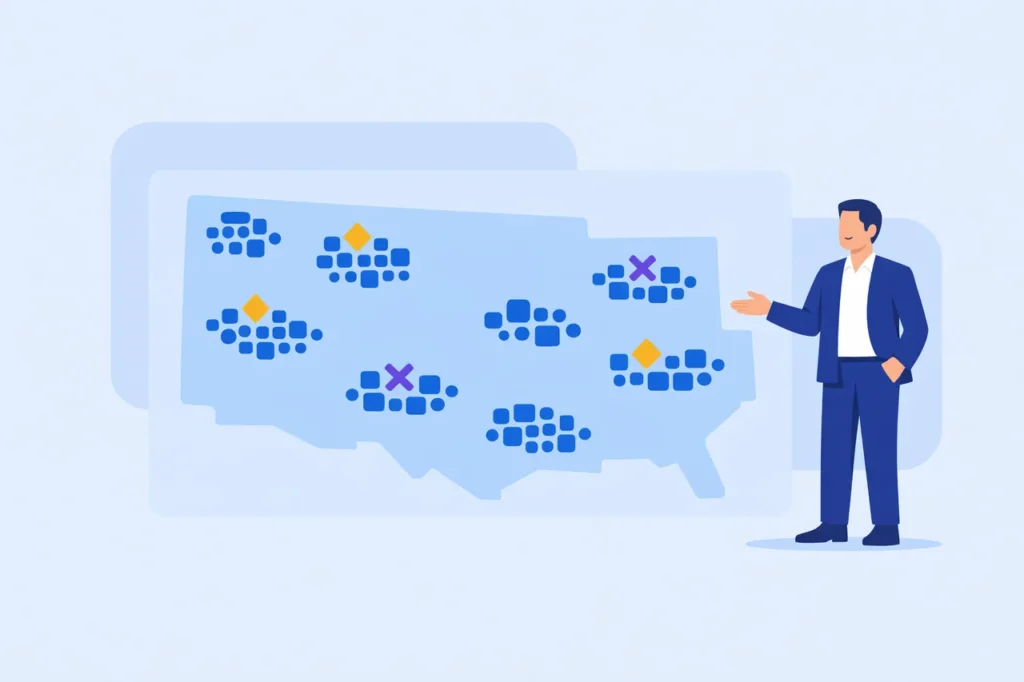
Three Legal Online Casino Paths US Players Have
The US online casino landscape runs on three parallel legal paths. Offshore casinos operate under international gaming licences (Curaçao, Anjouan, Kahnawake, Malta) and accept US players in all fifty states because federal law targets operators inside US jurisdiction, not players who use sites hosted abroad. State-regulated real-money casinos exist under state gambling law in eight states and are a nice option for residents who happen to live there. Sweepstakes casinos operate under US promotional sweepstakes law, using virtual coins that redeem for prizes, and cover roughly thirty-three states nationwide.
The three online casino paths at a glance
| Path | Offshore / State-regulated / Sweepstakes |
|---|---|
| US state availability | All 50 states / 8 states / ~33 states |
| Licensing authority | Curaçao, Anjouan, Kahnawake, Malta / State gaming boards / US sweepstakes law framework |
| Age minimum | 18+ typical (some 21+) / 21+ / 18+ default (some 21+) |
| Play currency | US dollars or crypto / US dollars / Gold Coins plus Sweeps Coins |
| Best for | Players anywhere in the US wanting maximum choice / Residents of the 8 regulated states / Casual free-play across most states |
Most players end up using one or two of these paths depending on preference. Serious real-money players outside the regulated eight almost always use offshore because the game selection, bonus generosity and betting range are much wider than sweepstakes offer. Residents of the eight regulated states have all three paths available to them and typically pick between regulated (for local convenience and fast domestic payouts) and offshore (for wider game libraries and crypto payment rails).
Offshore Casinos And Why They Work For US Players Everywhere
Offshore casinos are online operators licensed and hosted outside US jurisdiction that accept US player registrations. They are the largest and oldest segment of the US-facing online casino market, with US-facing operators running for over a decade and paying out billions in player winnings. The reason they can serve US players nationwide comes down to how US federal gambling law is written and what it actually prohibits.
What the Federal Wire Act and UIGEA actually target
The two main federal statutes cited around US online gambling are the Federal Wire Act of 1961 and the Unlawful Internet Gambling Enforcement Act of 2006. Both target OPERATORS and financial intermediaries, not players. The Wire Act prohibits sports-betting operators from using interstate wire communications for wagering transmissions. UIGEA prohibits payment processors from knowingly handling transactions for illegal online gambling operations. Neither statute contains a section that criminalizes an individual player for signing up at or playing at an offshore casino. That distinction is why offshore operators can legally accept US players even in states that have not passed their own online casino legislation.
Common offshore licences and what they cover
| Curaçao eGaming (Curaçao) | Most common licence at US-facing operators. Covers RNG game fairness, financial audit, KYC compliance. Dispute mechanism via the licensing master. |
|---|---|
| Anjouan Gaming (Comoros) | Increasingly common at newer offshore brands. Similar scope to Curaçao with somewhat lower operational overhead. |
| Kahnawake Gaming Commission (Canada) | Longstanding First Nations regulator, historically covers Bodog-family operators. Stricter game-fairness audit than Curaçao. |
| Malta Gaming Authority (Malta) | Highest-tier offshore regulator globally. Most MGA-licensed operators do not accept US players, but a few US-facing brands hold MGA in parallel with Curaçao for extra credibility. |
Where offshore is different from state-regulated in practice
The practical player-facing differences are three: payment methods (offshore leans heavily on crypto and bank wire, state-regulated uses standard US card and PayPal), dispute escalation (offshore goes through the licence regulator, state-regulated goes through the state gaming board), and game library depth (offshore libraries are typically larger because they source from more providers). Our shortlist of offshore no deposit bonuses covers the current best signup credits at the most trusted US-facing operators. For the full mix of no deposit bonus options in one place, see our current best no deposit bonus casinos.
The Eight States With A Regulated Local Option
Eight US states have passed their own online casino legislation and now operate state-licensed real-money markets. For residents of these states, the regulated brands available locally are an additional option on top of the offshore path. Each state runs its own gaming board with its own licensing process, its own bonus disclosure rules, and its own consumer protection framework, so brand selection and payout speed vary by state.

The eight states with regulated real-money casinos
| New Jersey (2013) | Deepest market, 25+ licensed operators, largest revenue base of any state |
|---|---|
| Pennsylvania (2019) | Second-largest market, ~20 operators, 54% effective tax on operator revenue |
| Michigan (2021) | ~15 operators, tribal-casino integration, sweepstakes explicitly banned in-state |
| West Virginia (2020) | Smaller market, ~8 operators, generous licensing terms |
| Connecticut (2021) | Exclusive tribal partnership model, only 3 operators licensed |
| Delaware (2013) | State-run monopoly via Delaware Lottery, limited game library |
| Rhode Island (2024) | Single-operator regulated market |
| Maine (2026) | Newest addition, tribal-exclusive operations, limited initial launch |
Sweepstakes Casinos As The Nationwide Alternative
Sweepstakes casinos operate under US promotional sweepstakes law rather than state gambling law, which is why they cover most US states without requiring individual state legislation. They use a two-currency system (Gold Coins for free entertainment play, Sweeps Coins that can be redeemed for cash or prizes) that keeps the whole model outside state gaming regulation. Around thirty-three states allow sweepstakes casinos with no restrictions, and roughly six states have banned or heavily restricted the model.

US sweepstakes casino state status
| Fully allowed | Around 33 states including CA, NY, TX, FL, IL, PA, GA, NC, OH, VA, plus most of the Midwest and Southeast |
|---|---|
| Fully banned | Washington, Idaho, Michigan (2024), Louisiana (2025), Nevada, Alabama |
| Operator-specific restrictions | Some operators decline players in NY, NJ, PA due to regulator pressure |
| Recent trend | State AG challenges accelerating; expect the banned-states list to grow through 2027 |
For most US players outside the regulated eight, sweepstakes is a good complement to offshore rather than a substitute. Sweeps Coins redeemed after 1x playthrough do become real cash or gift cards, and the biggest operators have documented redemption histories. Our deep dive into how sweepstakes casinos work covers the Gold Coin versus Sweeps Coin mechanic in detail.
What About Nevada, California, Texas And Florida
The four largest-population states each handle online casino differently, and none currently offer state-regulated real-money casino play. For players in these states, the picture is straightforward: offshore is universally available and sweepstakes is available in three of the four (banned in Nevada).
The big four population states
What is and is not available in the largest US markets.
| Feature | Offshore | State-regulated | Sweepstakes |
|---|---|---|---|
| California | Available | Not legal | Available |
| Texas | Available | Not legal | Available |
| Florida | Available | Not legal, Seminole compact controls land-based | Available at most operators |
| Nevada | Available | Online poker only, no casino | Sweepstakes banned outright |
Age Requirements By State
Age minimums vary by path and by state. Offshore casinos typically require 18 or older, though a few enforce 21 or older to align with their most restrictive market. State-regulated markets require 21 or older across all eight states. Sweepstakes casinos default to 18 or older with a small number of 21-plus state exceptions. Every operator verifies age via KYC during signup and cannot process withdrawals for underage players regardless of what they win.

Age minimums by path
| Offshore casinos | 18+ typical, some operators set 21+ across all US traffic |
|---|---|
| State-regulated real-money | 21+ universally across CT, DE, MI, NJ, PA, RI, WV, ME |
| Sweepstakes default | 18+ across most allowed states, 21+ in AL, HI, MA |
| Verification | KYC at signup with government ID plus proof of address across all three paths |
The Legislative Outlook For 2026 And 2027
State-level iGaming legalisation has slowed compared to the 2019 to 2021 wave. Roughly a dozen states have introduced online casino bills in recent sessions, though only Maine has actually passed one that reached launch. Offshore remains the nationwide constant while state-by-state expansion inches forward, and the next likely legal state (Maryland, Virginia, New York, or Illinois) is looking at a 2027 or 2028 launch at earliest.
What is realistic for the next 12 to 24 months
Maryland moved a Senate bill in 2026 but did not clear committee before the deadline. Virginia advanced two competing iGaming bills but failed to reconcile them in the 2026 session, with a reenactment clause pushing any launch to 2028 at earliest. New York carried an iGaming bill through committee in 2025 and could re-run it in 2026 or 2027. Illinois has active legislation being drafted. Meanwhile the offshore path continues to serve players in all 50 states with the widest game selection and largest bonus offers.
Frequently Asked Questions About US Online Casino Legality
Yes, in every state. Federal law (the Wire Act and UIGEA) targets operators and payment processors, not individual players. Offshore casinos with international licences accept US players nationwide. Eight states additionally offer their own state-regulated markets, and around 33 states also allow sweepstakes casinos. Almost every US player has multiple legal paths available.
Well-established offshore operators licensed by Curaçao, Anjouan, Kahnawake or Malta have long payout track records and are safe in practice. The key filters are licence validity, years in operation (three years or more), documented Reddit or Trustpilot payout records, and published RNG fairness certifications from iTech Labs or GLI. Brands passing all four filters function equivalently to state-regulated operators in reliability.
Offshore casinos operate under international gaming licences and accept US players in all 50 states, using US dollars or crypto. State-regulated casinos operate under state law in 8 states, using US dollars, and require you to be physically in-state to play. Sweepstakes casinos use virtual Gold Coins and Sweeps Coins that redeem for prizes, and cover roughly 33 states.
Yes for state-regulated markets. State-regulated operators check physical location, not residency, so if you are visiting Michigan for a weekend you can sign up and play at licensed Michigan operators while in-state, then stop when you leave. Offshore casinos do not require in-state location at all, so they work regardless of travel.
Curaçao eGaming is the most common at US-facing operators and is a valid licence. Anjouan Gaming is increasingly common at newer brands. Kahnawake Gaming Commission covers longstanding Bodog-family operators. Malta Gaming Authority is the highest-tier offshore regulator globally though most MGA-licensed operators do not accept US players. Any of these four is a legitimate signal that the operator is regulated.
The next likely candidates are Maryland, Virginia, New York, or Illinois in the 2027 to 2028 window. Legalisation has slowed compared to the 2019 to 2021 wave. In the meantime, offshore remains the nationwide constant with the widest game selection and largest bonuses.
Offshore casinos require 18 or older typically (some operators set 21). State-regulated markets require 21 across all 8 states. Sweepstakes casinos require 18 by default with a few 21-plus state exceptions. Operators verify age through KYC during signup.